

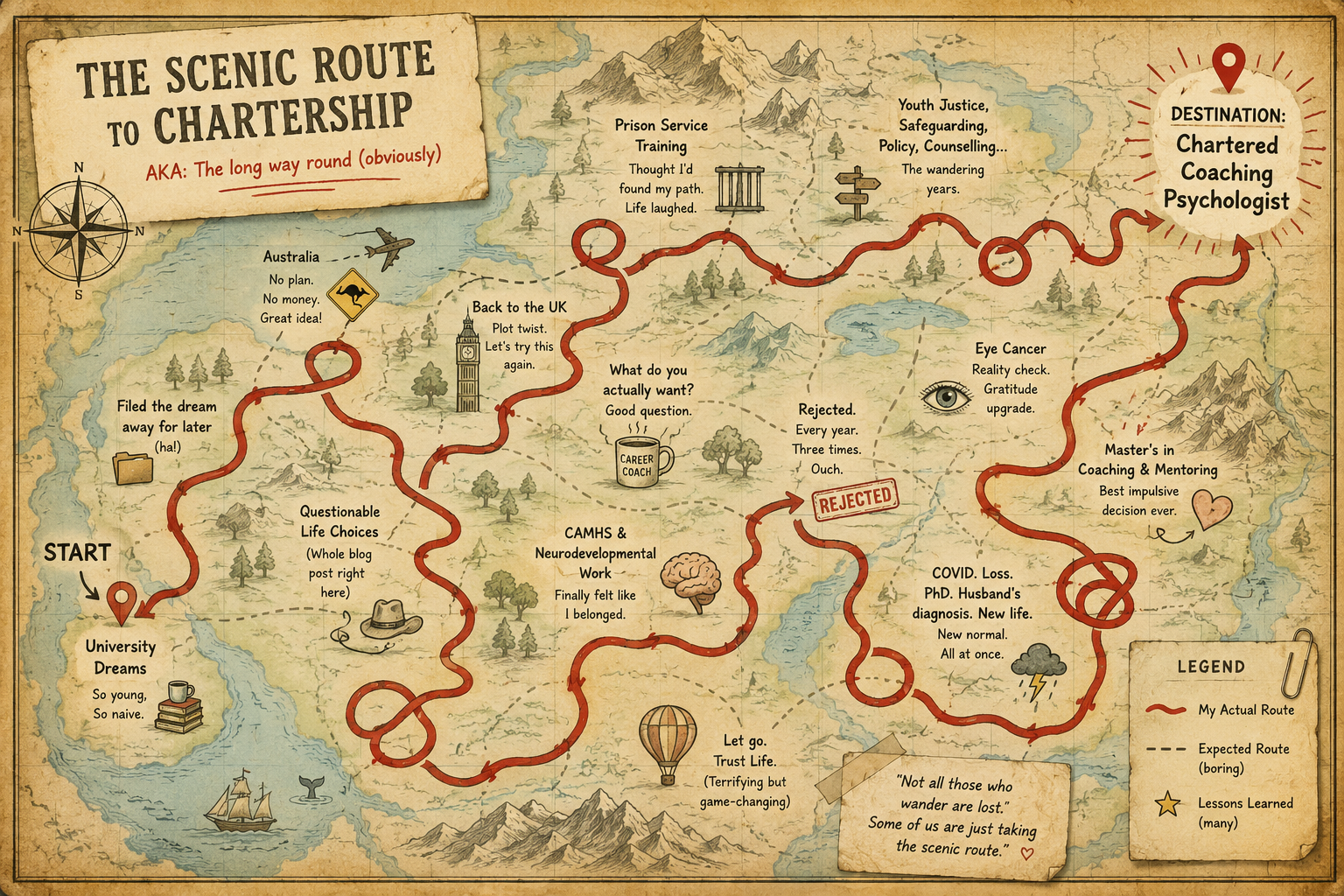
For years, becoming a psychologist felt like the dream that kept slipping just out of reach.
Ironically, I only achieved it once I’d stopped chasing it.
That probably sounds like one of those motivational quotes shared over pictures of mountains and sunsets, but in my case it’s true.
When I first went to university, I studied Psychology and Criminology. Unfortunately, my degree wasn’t accredited by the British Psychological Society, which meant that becoming a Chartered Psychologist wasn’t the straightforward path I’d imagined.
Back then, the message was clear.
Clinical psychology was fiercely competitive.
People with perfect grades got those places.
People like me didn’t.
So, I quietly filed the dream away and got on with life.
I worked as a Childcare Development Officer, helping secure funding to create childcare provision across Oxfordshire. It felt like my first proper career. I enjoyed it, even though I still had no idea where life was taking me.
Then I did what seemed entirely logical to my twenty-something self.
I quit my job and flew to Australia on my own.
I didn’t have much money, a plan or any idea. what I wanted to do with my life.
Looking back, this turned out to be excellent preparation for adulthood, which, as far as I can tell, mostly involves making things up as you go along.
Somehow, I’ve always trusted that I’d figure things out along the way.
That philosophy has served me surprisingly well.
It has also landed me in some spectacularly questionable situations.
One of those involved an American man whose story deserves an entire blog of its own. Suffice to say, the relationship became abusive and was followed by years of stalking and harassment.
When I eventually returned to the UK, something shifted.
I realised I still wanted to become a psychologist.
So I went back.
I completed my psychology conversion course, gained Graduate Membership of the British Psychological Society, and secured a role facilitating treatment programmes within the prison service.
I genuinely thought I’d finally found my path.
Life disagreed.
During training I openly disclosed the abuse and ongoing stalking I’d experienced. Rather than exploring how I was coping or assessing my wellbeing properly, the decision was simply made that it was “too soon” for me to undertake the role.
I failed the training.
Because passing the training was a condition of employment, I lost my job.
Looking back, that moment felt devastating.
It also effectively ended my hopes of becoming a psychologist.
Or so I thought.
Apparently Life had looked at my carefully constructed five-year plan and thought, “That’s adorable.”.
Instead, I found myself working across youth justice, community safety, safeguarding, domestic abuse and later policy. I trained as a psychotherapeutic counsellor. I supported children, families, offenders and frontline professionals.
Each role made perfect sense.
Only much later.
A career coach eventually asked me a simple question.
What did I actually want?
The answer surprised me.
I wanted to be a psychologist.
So once again I started rebuilding.
As I was working with a policy role at the time, I deliberately sought frontline experience, became an Assistant Psychologist within CAMHS, and later helped establish a neurodevelopmental service from the ground up.
I loved that work.
I finally felt as though I belonged.
I applied three times to get onto the funded Clinical Psychology doctorate programme, which you can only do once a year.
Year after year I was rejected before interview.
Anyone who has been through that application process knows how emotionally draining it can become. One application every year. Endless competency forms. Selection processes that somehow manage to reduce years of experience into a few hundred carefully crafted words.
I knew I was capable.
I simply never seemed to fit the mould.
Then everything changed.
In 2019 I was diagnosed with eye cancer.
Suddenly my career plans seemed far less important than simply staying alive.
Recovery forced me to stop pushing.
It also forced me to ask different questions.
By then my children were older.
Would I really uproot the whole family if I finally got onto a doctorate hundreds of miles away?
Would I even want to?
I briefly considered funding a Counselling Psychology doctorate myself.
I interviewed well.
Then I was told that it was too soon after my cancer diagnosis, but they would welcome me to join the following year.
At the time it felt like another closed door, and I genuinely believed Life was trying to tell me something.
Perhaps I simply wasn’t meant to become a psychologist.
So I let go.
And strangely, that changed everything.
On an impulse, I enrolled on a Master’s in Coaching and Mentoring.
It remains one of the best impulsive decisions I’ve ever made.
Then came COVID.
A close friend died unexpectedly.
I began a PhD.
A few months later my husband was diagnosed with Young Onset Alzheimer’s disease.
Within months we had sold our house, moved across the country, and overnight I became the family’s primary earner while raising two children, caring for my husband, building a business and attempting to complete a PhD.
It wasn’t exactly the five-year career plan I’d imagined.
Somewhere within all of that, coaching quietly stopped being something I did.
It became who I was.
Not because it was easier than psychology.
Because it allowed me to integrate everything I’d lived.
The psychology.
The counselling.
The justice work.
The neurodiversity.
The existential questions.
The grief.
The uncertainty.
The humanity.
Then something unexpected happened.
The British Psychological Society introduced a route to Chartered Coaching Psychologist.
The dream I’d abandoned years earlier quietly reappeared.
This time it wasn’t asking me to become someone else.
It recognised the psychologist I had already become.
First I had to finish my Master’s.
I suspended my PhD, completed my dissertation and graduated with a Merit.
Years ago that result might have disappointed me.
Now it represented something much more important.
Compassion.
There are seasons in life when excellence means accepting that “good enough” really is good enough.
Then came the chartership portfolio.
It wasn’t simply an assessment.
It was a chance to realise I’d already become the psychologist I’d spent twenty years trying to be.
And it’s part of a much longer and winding journey.
The little girl who struggled to read.
The student who thought she wasn’t clever enough.
The woman who repeatedly believed she’d missed her chance.
It turns out life wasn’t repeatedly telling me “no.”
It was saying, “Not that psychologist.” With a massive eye roll.
I’m finally learning to let go of trying to control the plot.
It’s a futile exercise anyway.
Life seems to prefer improvisation and so do I.
Rather than trying to enforce a script on Life, I embrace it. In all’s its misery and joy, the ups and the downs. The trick is not to take life too seriously, have more fun and play with improvisation.
Sometimes you spend years chasing one version of success, only to discover life has quietly been leading you towards something that fits you far better. Chartership doesn’t feel like the end of the story. It feels like confirmation that I’ve been on the right path all along.
It’s simply another chapter.
One I never expected to write.
And perhaps that’s the greatest lesson of all.
Sometimes the path you spend years trying to force open isn’t actually your path.
Sometimes life closes the door because there is another one waiting around the corner.
One that fits who you’ve become, not who you thought you were supposed to be.


Leave a Reply