

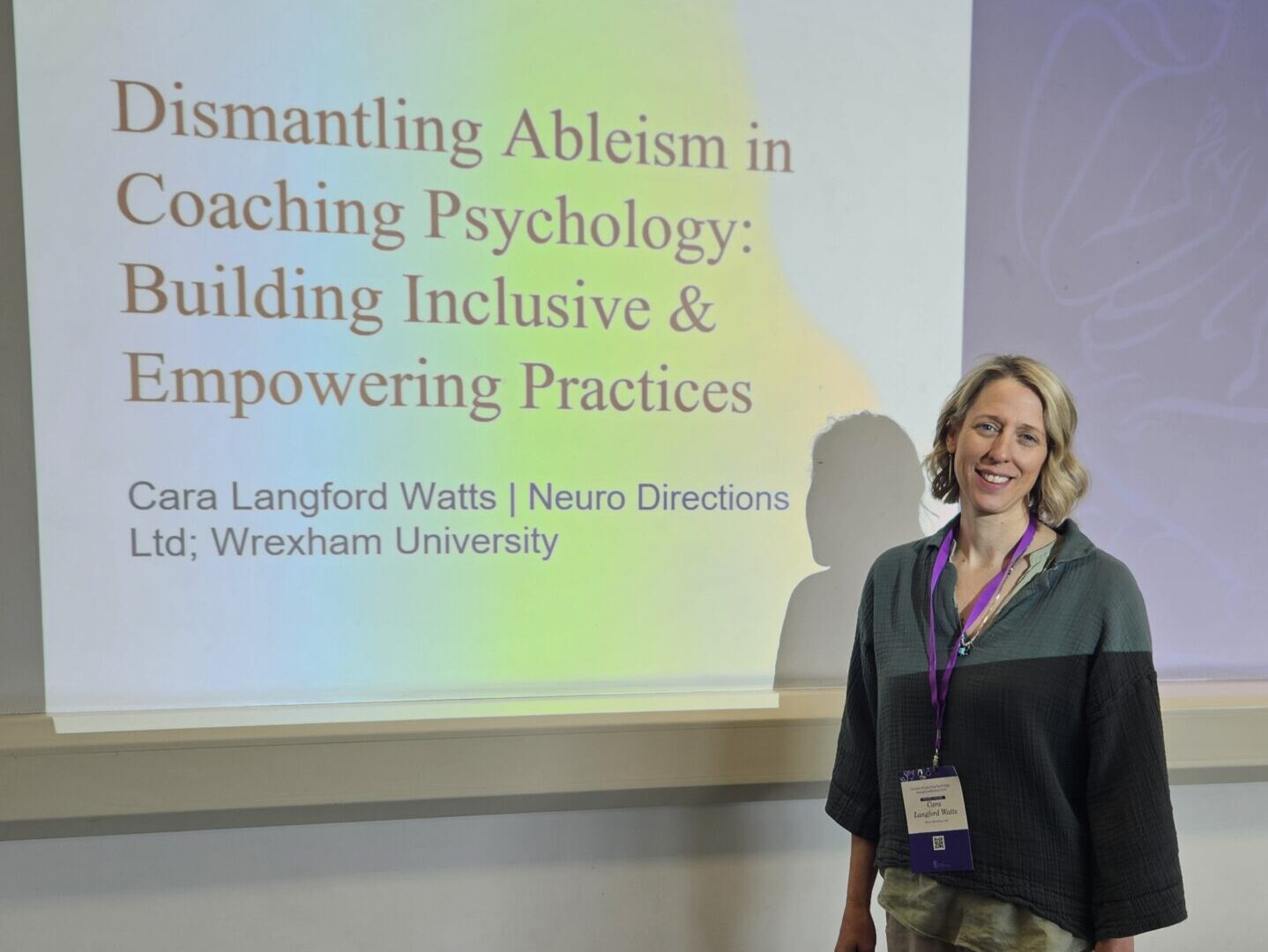
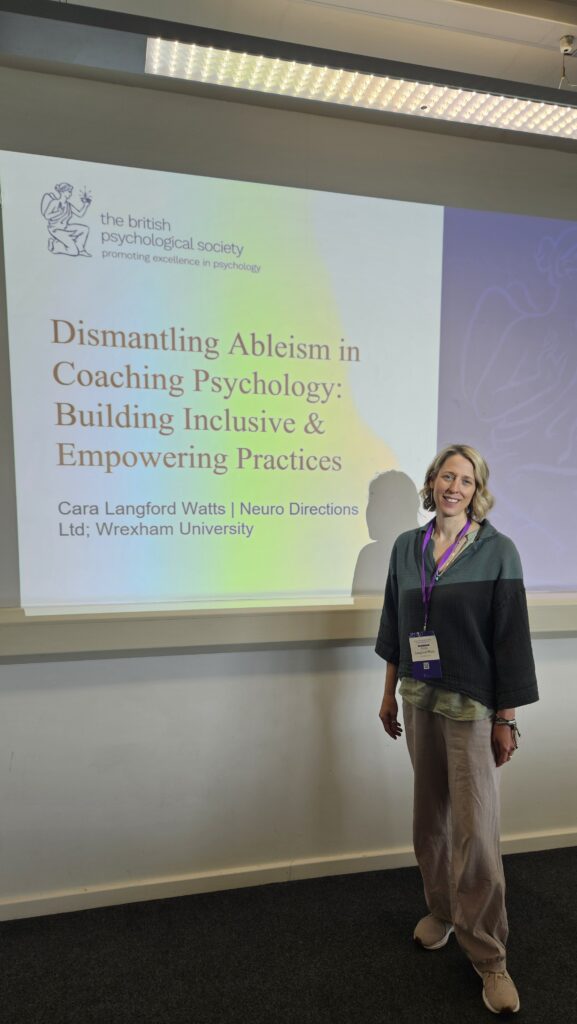
I was honoured to receive the Best Roundtable Presentation Award at the 2025 Division of Coaching Psychology Conference for a session exploring a question that sits at the heart of my work:
What happens when coaching unintentionally reproduces the very barriers it seeks to help people overcome?
Coaching is often presented as a neutral process. We talk about goals, performance, resilience, productivity, growth, and success as though these concepts are universal and value-free. Yet every coaching conversation takes place within a broader social, cultural, and political context. The assumptions we hold about what constitutes a “good life,” meaningful progress, or successful functioning are rarely neutral. They are shaped by dominant societal narratives.
One of those narratives is ableism.
Ableism refers to the privileging of certain ways of thinking, communicating, behaving, learning, working, and existing, while positioning other ways as deficient, problematic, or in need of correction. While overt forms of ableism are often recognised, more subtle forms can become embedded within professional practices, including coaching.
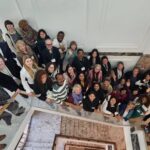
During the roundtable, participants explored a case example and engaged in reflexive discussion about how ableist assumptions can quietly shape coaching goals, interventions, and outcomes. Together, we considered questions such as:
- Who decides what “success” looks like?
- When does adaptation become pressure to conform?
- Are we helping clients flourish, or helping them fit into systems that were never designed for them?
- What assumptions sit beneath concepts such as productivity, motivation, communication, professionalism, and resilience?
These questions become particularly important when working with autistic individuals, people with ADHD, and other neurodifferent clients. Traditional coaching approaches often emphasise linear goal progression, behavioural modification, productivity enhancement, and performance optimisation. While these approaches can be helpful, they may also inadvertently reinforce the message that the client must change in order to be accepted.
Many neurodifferent individuals have spent years receiving explicit and implicit messages that they are “too much,” “not enough,” “too sensitive,” “too intense,” “too disorganised,” or simply wrong. Coaching that focuses solely on adaptation without questioning the systems that create these pressures risks reinforcing internalised ableism and further disconnecting individuals from their authentic ways of being.
The discussion also explored the potential for coaching psychology to become more than an individual change methodology. Coaching psychology has the capacity to act as a vehicle for social change by helping people critically examine the narratives that shape their identities, challenging deficit-based assumptions, and creating spaces where difference is not merely tolerated but genuinely valued.
This requires a shift from asking:
“How can this person function more effectively within the system?”
towards also asking:
“What aspects of the system need to change?”
Such an approach aligns with broader movements within psychology that recognise the importance of context, power, identity, and social justice. It invites coaches to move beyond individualistic explanations and to consider the wider structures that influence wellbeing, opportunity, and belonging.
The conversations that emerged during the session were thoughtful, courageous, and deeply encouraging. Participants shared reflections from their own practice, challenged assumptions, and explored what anti-ableist coaching might look like in action.
Receiving the award was a genuine honour, but the most meaningful aspect of the session was the collective willingness to engage with these complex questions. The discussion reinforced my belief that coaching psychology has an important role to play in creating a more inclusive future—one that recognises human diversity not as a problem to be solved, but as a valuable part of what it means to be human.
Thank you to everyone who attended, contributed, and helped create such a rich and reflective conversation. The work of challenging ableism is ongoing, and I look forward to continuing the dialogue together.


Leave a Reply