

Why the spaces we love can nourish, steady and help us return to ourselves.
A nourishing place does not simply look pleasant. It changes what becomes possible inside us.
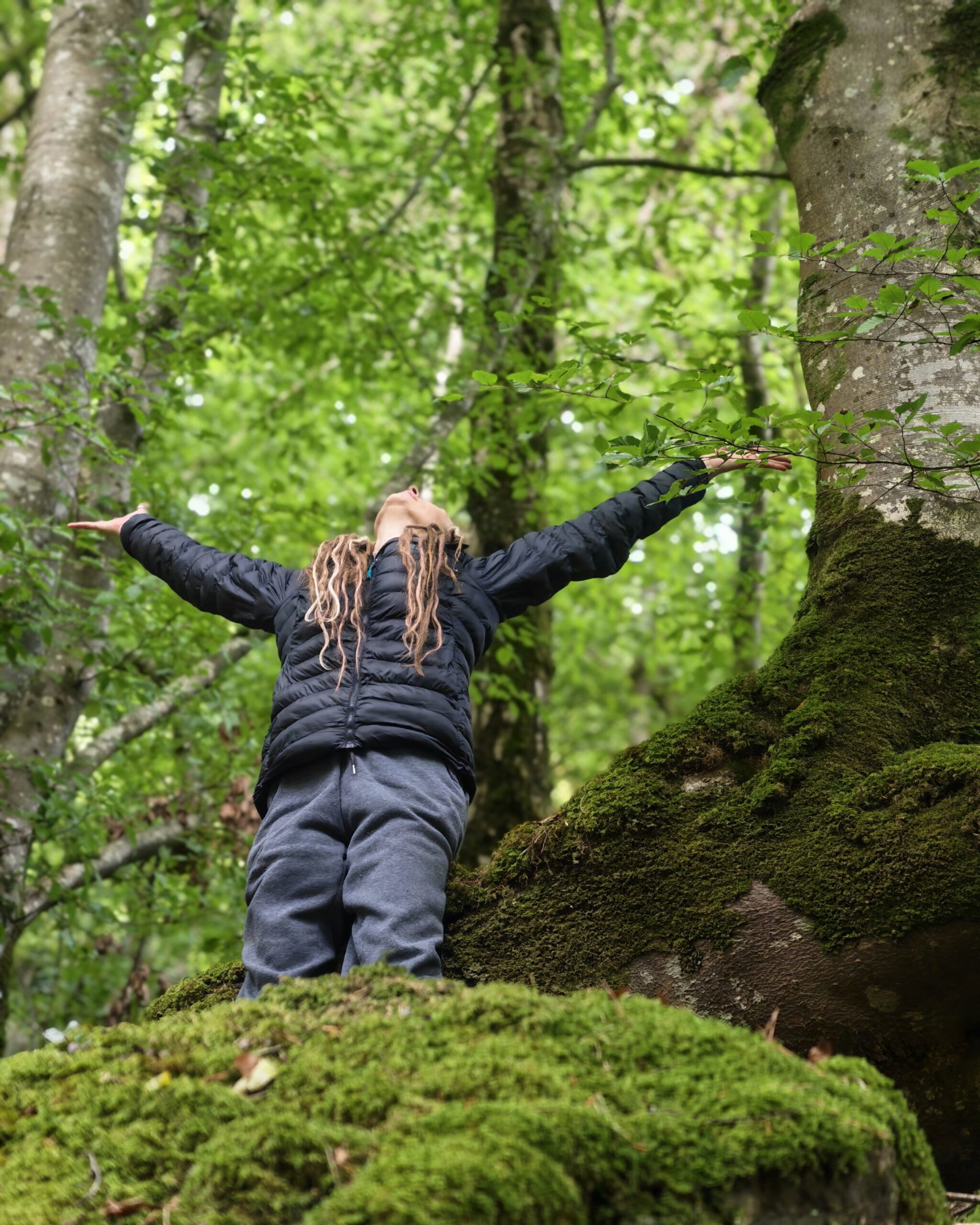
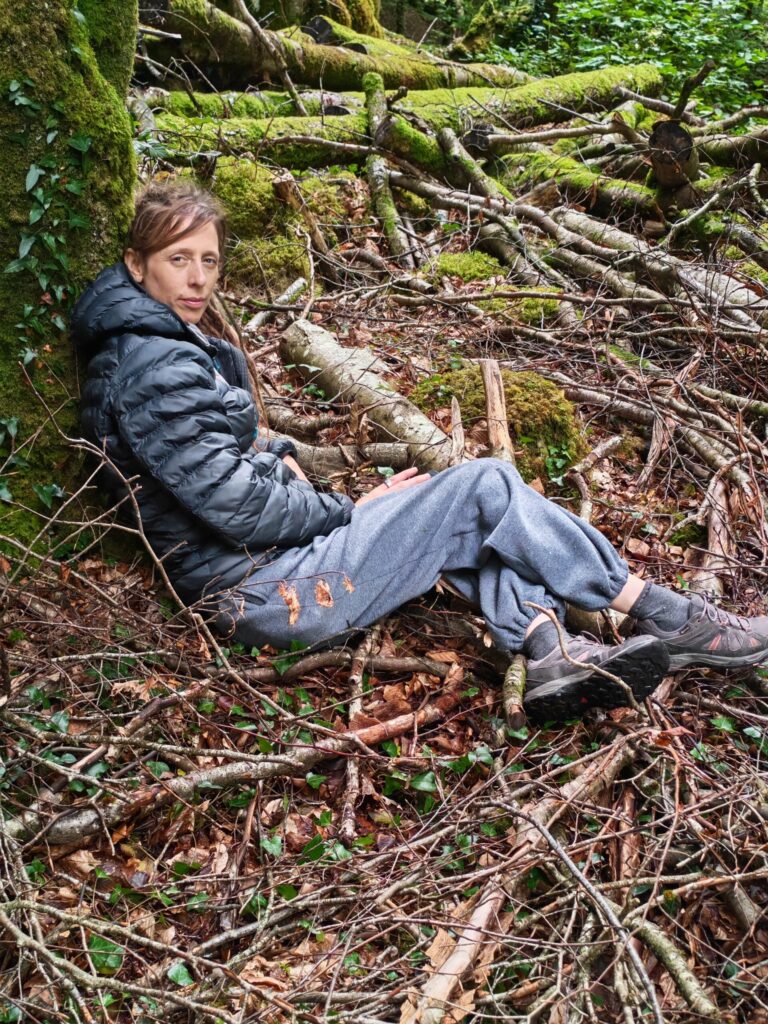
My happy place is a woodland. When I am stressed, I imagine myself there. I also keep pictures of trees and woodlands in my home – small openings onto a place where something in me can soften.
The phrase ‘happy place’ can sound sentimental, as though it belongs on a cushion rather than in serious conversation about wellbeing. Yet environmental psychology has spent decades studying much the same experience under less cushion-friendly names: restorative environments, place attachment, stress recovery, attention restoration and emotion regulation.
The research on nature and emotional regulation does not suggest that every difficult feeling can be cured by looking at a tree. Trees have enough to do. It does suggest something both simpler and more profound: our surroundings participate in how we feel, think and cope. Regulation is not only something we manufacture inside ourselves. It happens in relationship – with people, sensory conditions, routines, meanings and places.
We are not emotionally regulated in isolation
Much popular wellbeing advice treats stress as a private problem located somewhere between the ears. If we are overwhelmed, we are told to breathe better, think better, plan better or purchase a notebook designed to make all three aesthetically coordinated. These practices may help, but they can leave the environment strangely absent from the story.
A nervous system is always responding to context. Some places increase demand: noise, bright light, unpredictability, surveillance, social performance, clutter, interruption or the subtle sense that we must remain ready. Other places reduce demand. They allow attention to widen, vigilance to ease and the body to stop preparing for the next thing. A nourishing space may not make us cheerful. It may instead make room for us to think, grieve, create, rest or simply exist without having to perform our existence convincingly.
This is one reason the language of regulation matters. To say that a woodland feels regulating is not necessarily to say that it makes every feeling disappear. Regulation can mean becoming more able to stay present with what is here. The place does not erase the experience; it changes the conditions in which the experience is held.
Why woodland?
Woodlands offer a distinctive combination of shelter and openness, repetition and variation, stillness and movement. The canopy creates a boundary without becoming a wall. Leaves, bark, shadow and birdsong provide interest without usually demanding a response. There is pattern, but not monotony; change, but not necessarily chaos. An oak has never once asked me to clear my inbox before I am allowed to sit beside it.
Research on forest exposure – often discussed as shinrin-yoku or forest bathing – broadly supports its restorative potential. Systematic reviews and meta-analyses have reported short-term improvements in anxiety, low mood, anger and general psychological wellbeing, alongside reductions in stress-related measures such as cortisol and blood pressure when forest conditions are compared with urban settings or control conditions (Antonelli et al., 2019; Song et al., 2017; Wen et al., 2019; Kotera et al., 2020; Siah et al., 2023). A 2024 systematic review also found an emerging body of evidence linking contact with nature to emotion regulation, although the studies used varied definitions and measures (Rios-Rodriguez et al., 2024).
The cautious wording matters. Many forest-bathing studies have small samples, brief interventions and differing methods. It is often difficult to separate the woodland itself from walking, cleaner air, reduced traffic noise, time away from work, companionship, expectation or the rare novelty of nobody trying to sell us anything. The evidence is more persuasive for short-term restoration than for sweeping clinical claims or guaranteed long-term effects.
Two useful explanations – and a little scientific humility
Two theories frequently appear in this research. Stress Reduction Theory proposes that certain natural settings, particularly those experienced as safe, can evoke relatively rapid positive emotional and physiological responses. Attention Restoration Theory suggests that everyday life depletes the effortful attention we use to concentrate and inhibit distractions. Natural environments can engage ‘soft fascination’: they hold attention gently enough to give directed attention a rest.
Attention Restoration Theory describes restorative settings as offering a sense of being away, sufficient scope or coherence, gentle fascination and compatibility with what a person needs or wants to do. Woodland can offer all four. It can create psychological distance from ordinary demands; feel like a whole world rather than a decorative object; invite effortless noticing; and fit a wish to walk, sit, wander or be quiet.
The theory is helpful, but it is not woodland gospel. Systematic and critical reviews have found that objective tests of attention do not always improve consistently after nature exposure, and alternative explanations have not been fully ruled out (Ohly et al., 2016; Joye & Dewitte, 2018). A theory can illuminate an experience without owning it. Sometimes science gives us a map; occasionally it behaves as though it planted the forest.
When the woodland comes home
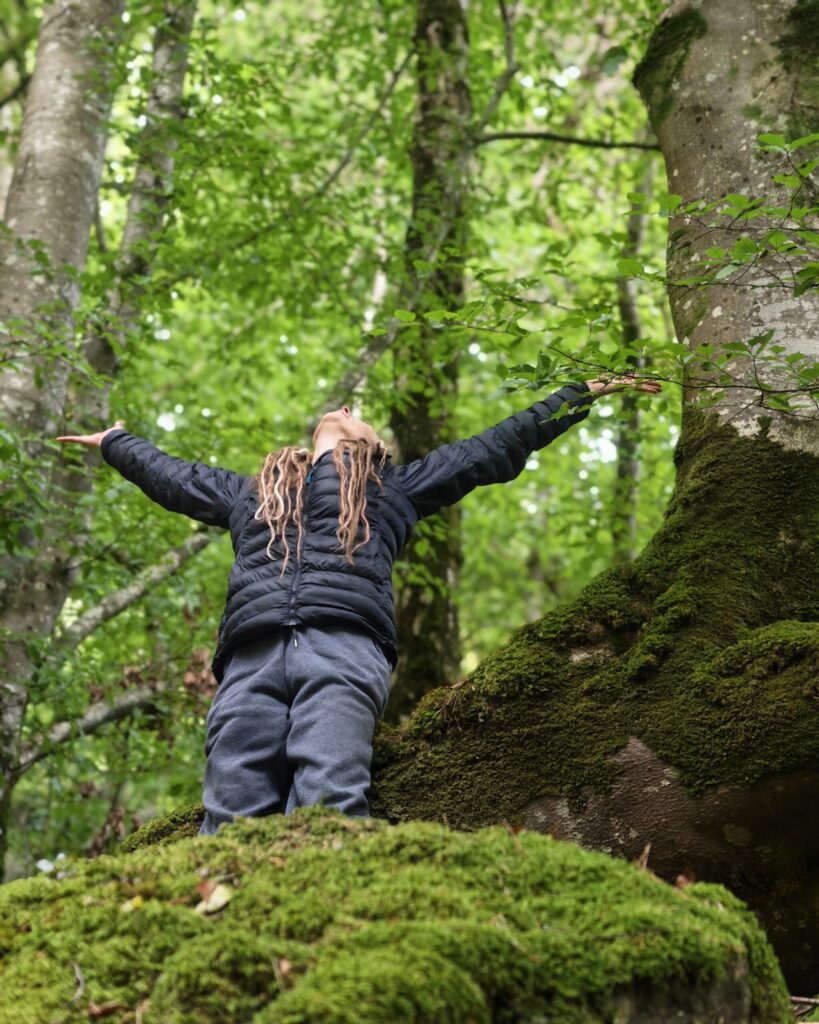
I have pictures of trees and woodlands in my home. They are beautiful, but their value is not only decorative. Research on indirect or ‘surrogate’ nature suggests that photographs, videos and immersive virtual environments can sometimes improve mood, reduce stress and support aspects of restoration. A systematic review of virtual nature found broadly beneficial psychological and psychophysiological outcomes, although study quality, media formats and effects varied substantially (Spano et al., 2023).
One small two-week study asked participants to use a nature picture actively as a way of regulating everyday emotion. The clearest change was in positive mood rather than across every measured outcome (Johnsen & Rydstedt, 2013). That is a modest result, but a useful one. A picture does not need to reproduce an entire ecosystem to matter. It may interrupt a demanding visual field, attract attention gently, evoke memory or remind us of a relationship that already carries meaning.
A photograph is not the same as standing among trees. It cannot provide changing air, texture underfoot, scent, temperature, depth or the unscripted presence of other species. Yet ‘not the same’ does not mean ‘not real’. Images and virtual experiences may be especially valuable when pain, disability, fatigue, caring responsibilities, unsafe surroundings, lack of transport or the weather make physical access difficult. Advice to ‘just get outside’ is less a wellbeing strategy than an accidental audit of somebody else’s privilege.
Imagining a place back into reach
When I am stressed, I sometimes imagine myself in a woodland. There is now a small but intriguing evidence base for this too. In an experimental study, both nature-based and urban guided imagery reduced state anxiety, but the nature-based imagery produced a greater reduction (Nguyen & Brymer, 2018). Another study found that imagining oneself in a restorative natural setting generated more positive emotion and relaxation than imagining non-restorative urban settings or even restorative built settings such as a gallery or spa (Koivisto & Grassini, 2023).
The personal meaning of the place may be as important as its category. Research on favourite places suggests that they can support self-regulation, and natural settings are often overrepresented among the places people choose (Korpela et al., 2001). In a series of experiments, people felt more psychologically fulfilled when they imagined a place they felt emotionally connected to, rather than somewhere that was simply familiar (Scannell & Gifford, 2017). Studies of environmental preference also suggest that restoration is partly shaped by the fit between a person and a setting, not simply by whether researchers have labelled the photograph ‘nature’ (Wilkie & Clements, 2018).
My imagined woodland is therefore not just a generic collection of trees. It is a place already woven with familiarity, meaning and anticipated safety. The image on the wall can act as a threshold; imagination can complete the path.
This does not mean imagination should be used to deny distress or permanently leave the present. Its function matters. Used gently, an imagined place can give the body and attention another point of reference: not ‘nothing is wrong’, but ‘this difficult moment is not the whole landscape’. The aim is not forced calm. It is enough space to regain choice.
The right place, not the prescribed place
Not everyone is nourished by woodland. For one person it may offer sanctuary; for another, mud, insects, uncertain footing, darkness or the opening scene of a regrettable folk-horror film. A coast, library, kitchen, allotment, workshop, place of worship, familiar cafe or lively city street may provide somebody else with the right combination of belonging, interest, memory and sensory fit.
This is important because wellbeing practices quickly become moral instructions. Nature is beneficial, therefore everybody should hike; meditation is beneficial, therefore everybody should sit still; routines are beneficial, therefore everybody should own a colour-coded planner. But a regulating environment is not defined by fashion or prescription. It is defined through relationship. Compatibility matters.
For neurodifferent people in particular, it can be useful to notice the specific sensory and relational qualities of a nourishing place rather than assuming that its broad category explains everything. Is it the filtered light, muted sound, predictable pathways, freedom from eye contact, permission to move, absence of social demand, spaciousness or enclosure? The more precisely we understand what the place offers, the more creatively we can make elements of it available elsewhere – without pretending that a framed photograph and an ancient woodland are interchangeable commodities.
When the place joins the coaching conversation
If environments participate in regulation, they also participate in coaching. Coaching is sometimes imagined as a conversation between two self-contained minds, conducted in a pleasantly neutral room—as though the chairs, lighting, noise, posture and expectation of eye contact have signed an agreement not to influence proceedings. They have not.
Where we speak can influence how we speak. How we move can shape what we notice. The conditions surrounding a conversation can narrow or expand what feels thinkable, speakable and possible.
Shinrin-yoku offers a useful bridge into this idea. Forest bathing is not coaching, and outdoor coaching is not simply forest bathing with questions added. Both, however, challenge the assumption that reflection happens only inside the head. They invite attention to become embodied, sensory and situated within a wider living environment.
Outdoor coaching allows the place to become part of the coaching encounter rather than merely its backdrop. Walking side by side changes the physical and relational arrangement. Coach and client are no longer positioned opposite one another; the pace can quicken, slow or pause, and silence may feel less like an awkward gap waiting to be professionally filled. Attention can move between the conversation, the body and the surrounding landscape.
Research specifically on outdoor coaching remains limited but encouraging. In a small quasi-experimental study, people experiencing work-related stress and burnout reported greater improvements in burnout, work enjoyment, mental health and self-esteem after a walk-and-talk coaching programme than participants receiving no intervention (van den Berg & Beute, 2021). However, because the comparison group received no coaching, the study cannot tell us whether these changes came from coaching, walking, nature, the programme activities or—most plausibly—the relationship between them.
Qualitative research adds a more experiential picture. Walking-coaching clients have described greater fluidity and clarity of thought, learning through their encounters with nature, and movement towards acceptance and restoration of self (Ivaldi, 2024). Other participants have spoken about sensory awareness, a calmer quality of attention, the rhythm of walking beside their coach and the spontaneous metaphors offered by the landscape (Burn & Passmore, 2022).
A fork in the path may give form to a decision. A clearing might make a possibility more visible. A fallen tree may prompt reflection on disruption, adaptation or what continues to grow around loss. This does not mean the coach needs to declare that every broken branch represents a limiting belief. Nature is not an outdoor personality test. The meaning belongs to the person noticing it.
This fits with a contextual understanding of coaching. Insight is not manufactured inside an isolated individual and then exported into their life. It emerges through relationships among body, movement, language, history, place and possibility. Sometimes changing the setting changes the conversation, not because the woodland provides answers, but because it creates different conditions in which questions can be encountered.
For some neurodifferent people, walking, looking alongside rather than directly at another person, moving while thinking or sharing attention with the environment may reduce certain demands. For others, weather, uneven ground, insects, unfamiliarity, limited privacy or sensory unpredictability may create more demand, not less. There is no gold medal for achieving personal insight while negotiating a muddy stile.
Neuro-affirmative outdoor coaching must therefore begin with choice. It might involve walking through woodland, sitting in a garden, using an accessible path or meeting beside water. It might also mean bringing elements of a meaningful place into an indoor or online session through photographs, sounds, objects, memories or guided imagery. Outdoor coaching is not inherently deeper, healthier or more authentic than coaching indoors. Its value depends on the person, the place and the relationship between them.
Perhaps the question is not, “Is coaching better outdoors?” but, “What conditions help this person think, feel, speak, move and choose?” When the setting is selected collaboratively and with care, outdoor coaching becomes more than an ordinary coaching conversation relocated beside an obliging oak. It becomes coaching in relationship with place.
Bringing a nourishing place closer
We can begin by becoming curious about the places in which we feel more able to be ourselves. These questions are not a test and do not require an immediate answer. They are invitations to notice a relationship that may already be supporting us.
Where do I stop bracing? Notice the places in which breathing, posture, attention or inner pace changes without being forced.
What does the place ask of me – and what does it not ask? A nourishing space may reduce sensory effort, decision-making, social performance or vigilance.
Which details carry the relationship? It may be colour, sound, scent, texture, temperature, movement, memory, symbolism or the presence of particular living beings.
How can I create more than one route back? A visit may be one route. A photograph, remembered path, sound recording, natural object, piece of art, or brief sensory image may be another.
The intention is not to construct a perfectly optimised calming environment – yet another project at which to fail attractively. It is to develop a flexible ecology of support. On some days, the woodland may be physically reachable. On others, a picture, memory or thirty seconds of imagined light through leaves may be what is available. Accessibility is not a lesser version of the practice; it is part of designing the practice honestly.
If a place holds us, how do we hold it?
There is an ethical tension in describing nature as therapeutic. The language can turn a living community into a service provider: woodland as spa, birdsong as soundtrack, trees performing unpaid emotional labour while humans collect the wellbeing benefits. A forest is not scenery. It is habitat, relationship and a network of lives with value beyond their usefulness to us.
Perhaps being nourished by a place creates responsibility as well as benefit. We can visit without damaging, learn what and who lives there, support equitable access, protect mature trees and habitats, resist treating green space as decorative surplus, and pay attention to whose safety and mobility are considered in decisions about land. Reciprocity does not diminish restoration. It deepens it, replacing consumption with participation.
The places that help us return
My happy place is a woodland. Sometimes I can go there. Sometimes I meet it through a picture. Sometimes I close my eyes and walk an inner path towards it. These experiences are not identical, and the research does not claim that they are. But each can be a genuine form of contact with a place that has become part of how I know safety, spaciousness and myself.
Nourishing places remind us that we are not self-contained machines expected to regulate efficiently under any conditions. We are porous, contextual and relational beings. The spaces around us enter our attention, shape our possibilities and sometimes help carry what is too heavy to hold alone.
Perhaps the more useful question is not simply, ‘How do I regulate myself?’ It is: ‘Which people, places and relationships make regulation more possible – and how might I care for them in return?’
Research note
The evidence is strongest for short-term psychological and physiological outcomes following direct nature exposure. Research on photographs, virtual nature, mental imagery and personally meaningful places is promising but smaller and methodologically varied. These approaches are best understood as accessible resources that may support regulation, not as replacements for clinical care or structural changes to stressful living conditions.
Follow me on
How I write: AI and accessibility
I use AI tools as assistive technology to support my writing, particularly with the challenges I experience around dyslexia. They help me organise my thoughts, develop and revise drafts, create a clear structure, and work through wording, spelling and grammar. Having ideas is rarely the problem; persuading them into an orderly queue can be.
Using these tools allows me to focus more of my energy on what I want to communicate, rather than the mechanics of getting it onto the page. My work is shaped by my knowledge, experience and critical reflection. I make the final editorial decisions and take responsibility for what I publish. AI supports my process; it does not replace my judgement.
References
Antonelli, M., Barbieri, G., & Donelli, D. (2019). Effects of forest bathing (shinrin-yoku) on levels of cortisol as a stress biomarker: A systematic review and meta-analysis. International Journal of Biometeorology, 63(8), 1117-1134. DOI: 10.1007/s00484-019-01717-x
Johnsen, S. A. K., & Rydstedt, L. W. (2013). Active use of the natural environment for emotion regulation. Europe’s Journal of Psychology, 9(4), 798-819. DOI: 10.5964/ejop.v9i4.633
Joye, Y., & Dewitte, S. (2018). Nature’s broken path to restoration: A critical look at Attention Restoration Theory. Journal of Environmental Psychology, 59, 1-8. DOI: 10.1016/j.jenvp.2018.08.006
Koivisto, M., & Grassini, S. (2023). Mental imagery of nature induces positive psychological effects. Current Psychology, 42, 30348-30363. DOI: 10.1007/s12144-022-04088-6
Korpela, K., Hartig, T., Kaiser, F. G., & Fuhrer, U. (2001). Restorative experience and self-regulation in favorite places. Environment and Behavior, 33(4), 572-589. DOI: 10.1177/00139160121973133
Kotera, Y., Richardson, M., & Sheffield, D. (2020). Effects of shinrin-yoku (forest bathing) and nature therapy on mental health: A systematic review and meta-analysis. International Journal of Mental Health and Addiction, 20, 337-361. DOI: 10.1007/s11469-020-00363-4
Nguyen, J., & Brymer, E. (2018). Nature-based guided imagery as an intervention for state anxiety. Frontiers in Psychology, 9, 1858. DOI: 10.3389/fpsyg.2018.01858
Ohly, H., White, M. P., Wheeler, B. W., et al. (2016). Attention Restoration Theory: A systematic review of the attention restoration potential of exposure to natural environments. Journal of Toxicology and Environmental Health, Part B, 19(7), 305-343. DOI: 10.1080/10937404.2016.1196155
Rios-Rodriguez, M. L., Rosales, C., & Hernandez, B. (2024). Benefits for emotional regulation of contact with nature: A systematic review. Frontiers in Psychology, 15, 1402885. DOI: 10.3389/fpsyg.2024.1402885
Scannell, L., & Gifford, R. (2017). Place attachment enhances psychological need satisfaction. Environment and Behavior, 49(4), 359-389. DOI: 10.1177/0013916516637648
Siah, C. J. R., Goh, Y. S., Lee, J., et al. (2023). The effects of forest bathing on psychological well-being: A systematic review and meta-analysis. International Journal of Mental Health Nursing, 32(4), 1038-1054. DOI: 10.1111/inm.13131
Song, C., Ikei, H., & Miyazaki, Y. (2017). Blood pressure-lowering effect of shinrin-yoku (forest bathing): A systematic review and meta-analysis. BMC Complementary and Alternative Medicine, 17, 409. DOI: 10.1186/s12906-017-1912-z
Spano, G., Theodorou, A., Reese, G., et al. (2023). Virtual nature, psychological and psychophysiological outcomes: A systematic review. Journal of Environmental Psychology, 89, 102044. DOI: 10.1016/j.jenvp.2023.102044
Wen, Y., Yan, Q., Pan, Y., Gu, X., & Liu, Y. (2019). Medical empirical research on forest bathing (shinrin-yoku): A systematic review. Environmental Health and Preventive Medicine, 24, 70. DOI: 10.1186/s12199-019-0822-8
Wilkie, S., & Clements, H. (2018). Further exploration of environment preference and environment type congruence on restoration and perceived restoration potential. Landscape and Urban Planning, 170, 314-319. DOI: 10.1016/j.landurbplan.2017.04.013



Leave a Reply